
Your shape didn't change. The opponent's did.
How to adjust a 4-4-2, a 4-3-3 or a 3-4-3 to the team in front of you, without giving up the five principles your defending depends on.
Nine matchups + the Collective Defensive Principles chapter. Closes Thursday, September 24 at 11:59 PM Pacific. It won't be available again for at least six months.
Built by a Performance Individual Analyst working with professional players in La Liga — currently with an international with 50+ caps.
Same team, same instructions, a different Saturday
Two Saturdays ago your press worked. Every player knew who was his. The ball went wide, came back inside, and you won it there.
Last Saturday the other team built with a number six close to their center backs. Three players against your two strikers. One of them was free every time, usually the six, facing forward. Your strikers ran more and won less, and by the second half they had nothing left for the counterattack.
You can ask for more intensity. Or you can ask a different question: in this matchup, who owns their six? Who joins the first line? Who is the spare player behind?
When those answers are clear, players press with conviction. When they aren't, they run.
This is not about formations
“This is not about formations. It's about how we adjust our formation to achieve our principles.”
Whatever shape you play and whatever block you defend in, your team is trying to do the same five things:
- Put pressure on the ball
- Balance and cover the player who presses
- Stay compact as a whole block
- Protect the depth
- Be ready to counterattack
Every opponent shape breaks one of these somewhere. The work is finding where, and making the smallest adjustment that restores it with references your players can recognize. Sometimes that means moving one midfielder. Sometimes it means changing the front three. Twice out of nine, it means changing nothing at all.
Nine matchups, one way of reading them
| You defend ↓ They build → | 4-4-2 | 4-3-3 | 3-4-3 |
|---|---|---|---|
| 4-4-2 | 11:26 | 13:35 | 11:40 |
| 4-3-3 | 11:08 | 9:57 | 8:09 |
| 3-4-3 | 12:43 | 7:48 | 7:27 |
| + Collective Defensive Principles · 17:15 · only in this release | |||
Each cell is one video, with its real length. Nine matchups: 1h 34m.
The videos follow the same order, so after two or three you start doing it yourself.
- What the matchup gives you for free
- Where one of the five principles breaks
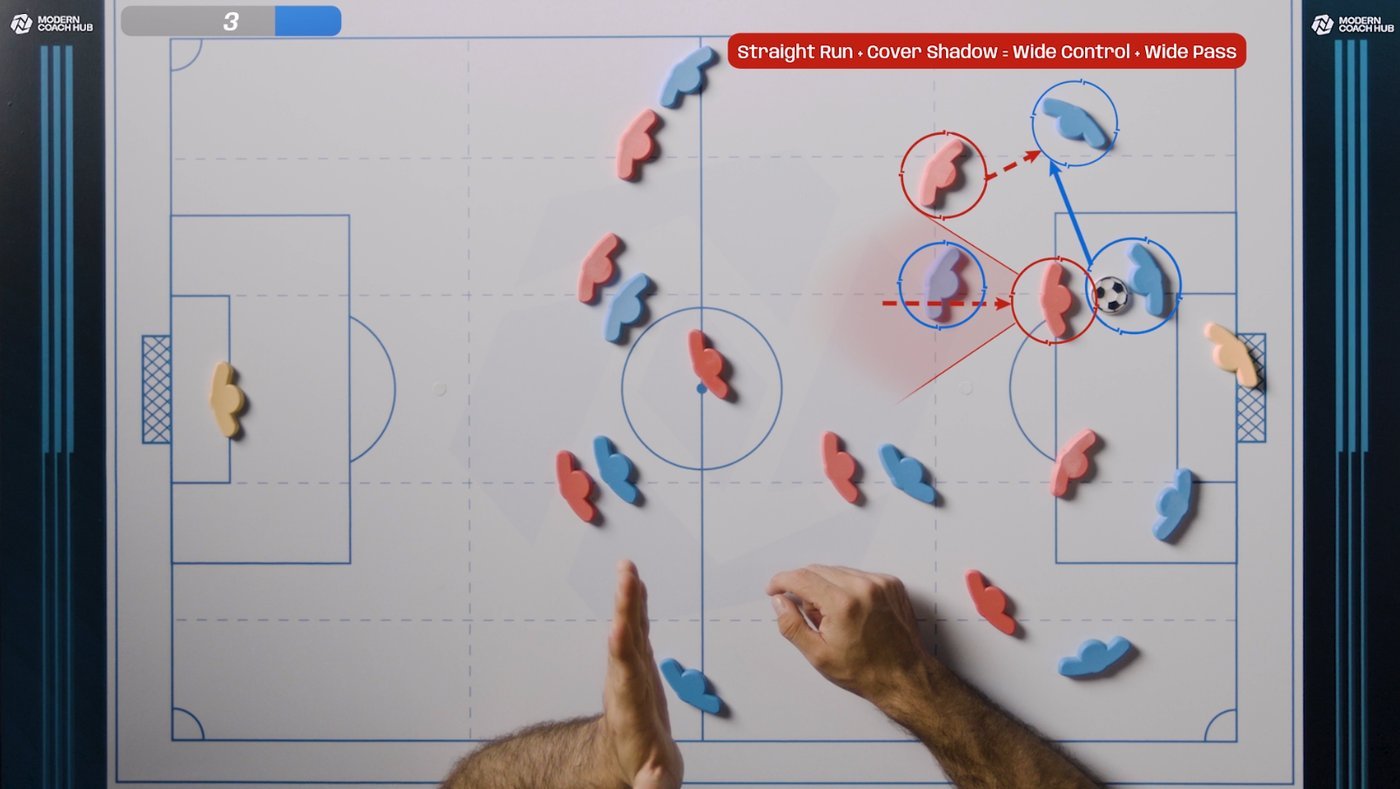
- The adjustment, and which opponent detail decides it: the width of their center backs, the height of their fullbacks, where their six stands
- Who protects the depth, and when a midfielder should or shouldn't drop into the back line
- In most matchups, where you're likely to win the ball and who finishes the counterattack
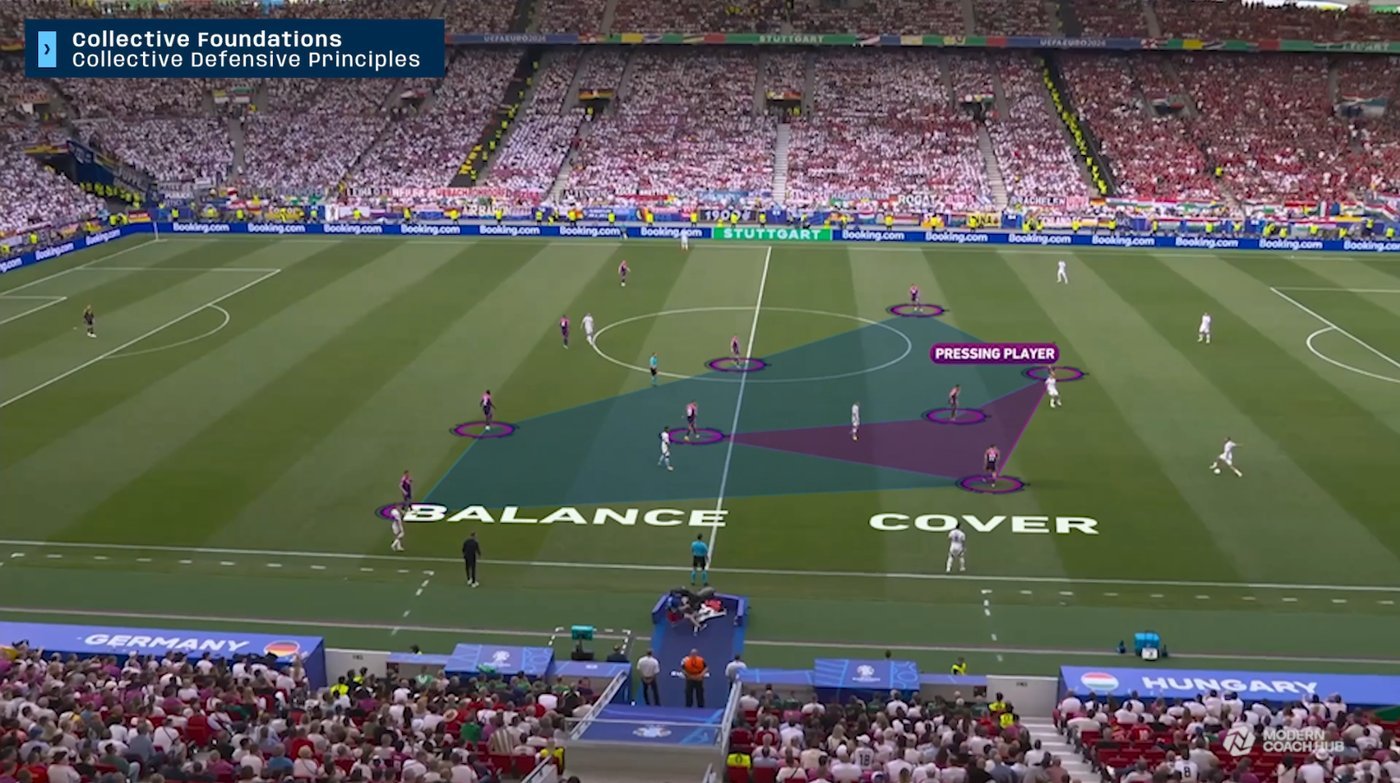
The chapter from Defensive Master that defines the five principles the nine matchups are built on, and why they hold whether you defend in a high press, a mid block or a low block.
Each matchup has its own page of notes for the coach: the 3 key points, how each of the five principles holds up, and the Cue → If → Then decisions to agree on with your players. See an extract below.
In numbers: 9 matchup videos (1h 34m) + the principles chapter (17 minutes), plus written notes for every video. Short on purpose. It's meant to be used, not binge-watched.
Built on the board, checked against real matches
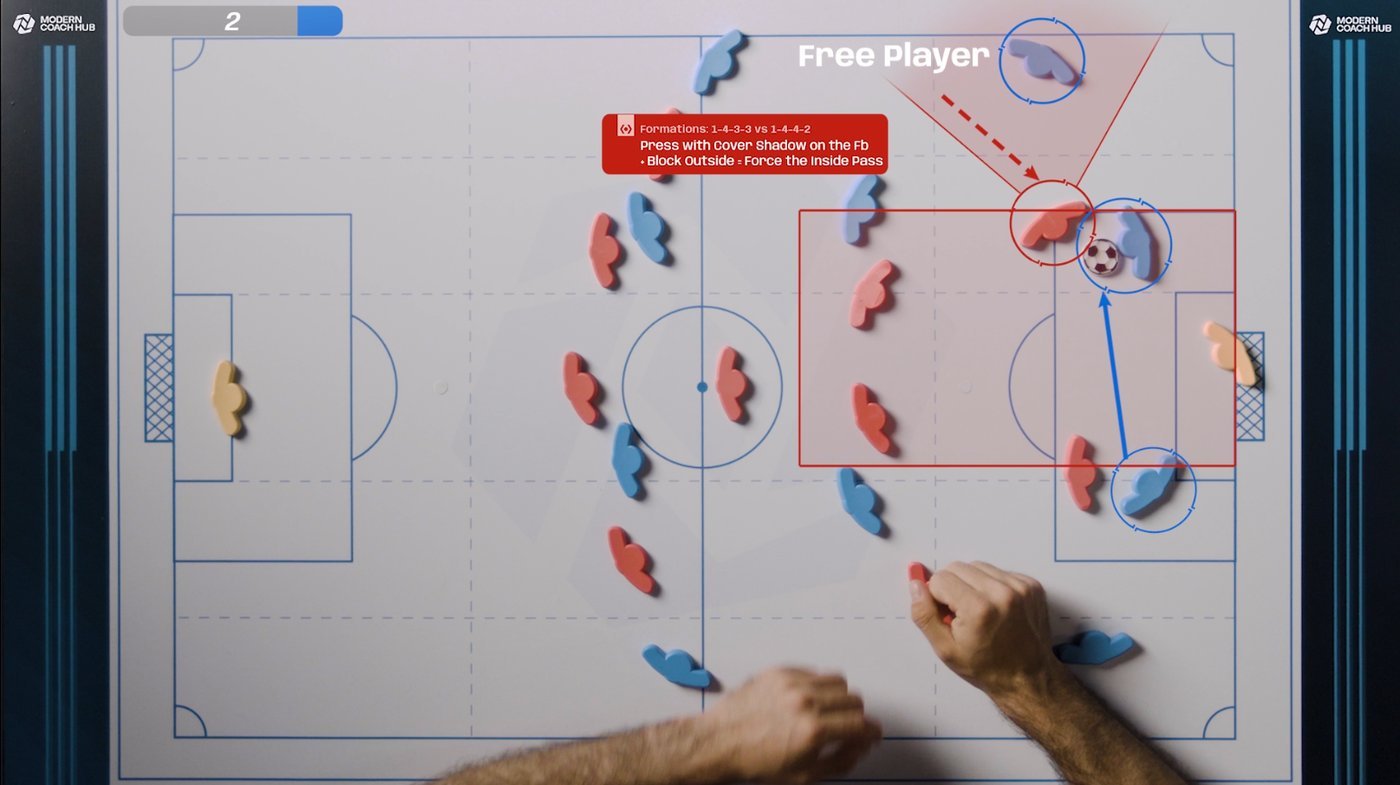
The matchups are worked on the tactic board, piece by piece. The principles chapter shows them in real games. Swipe through.
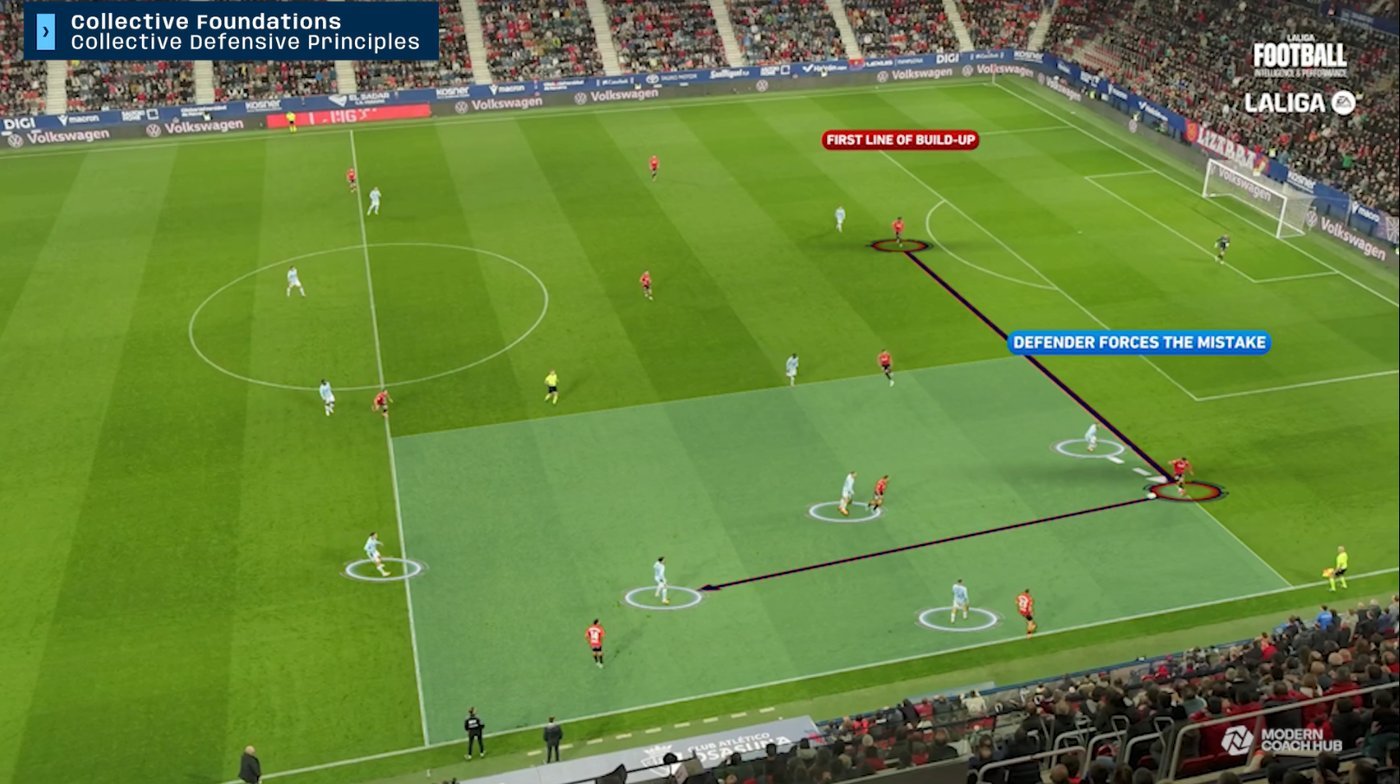
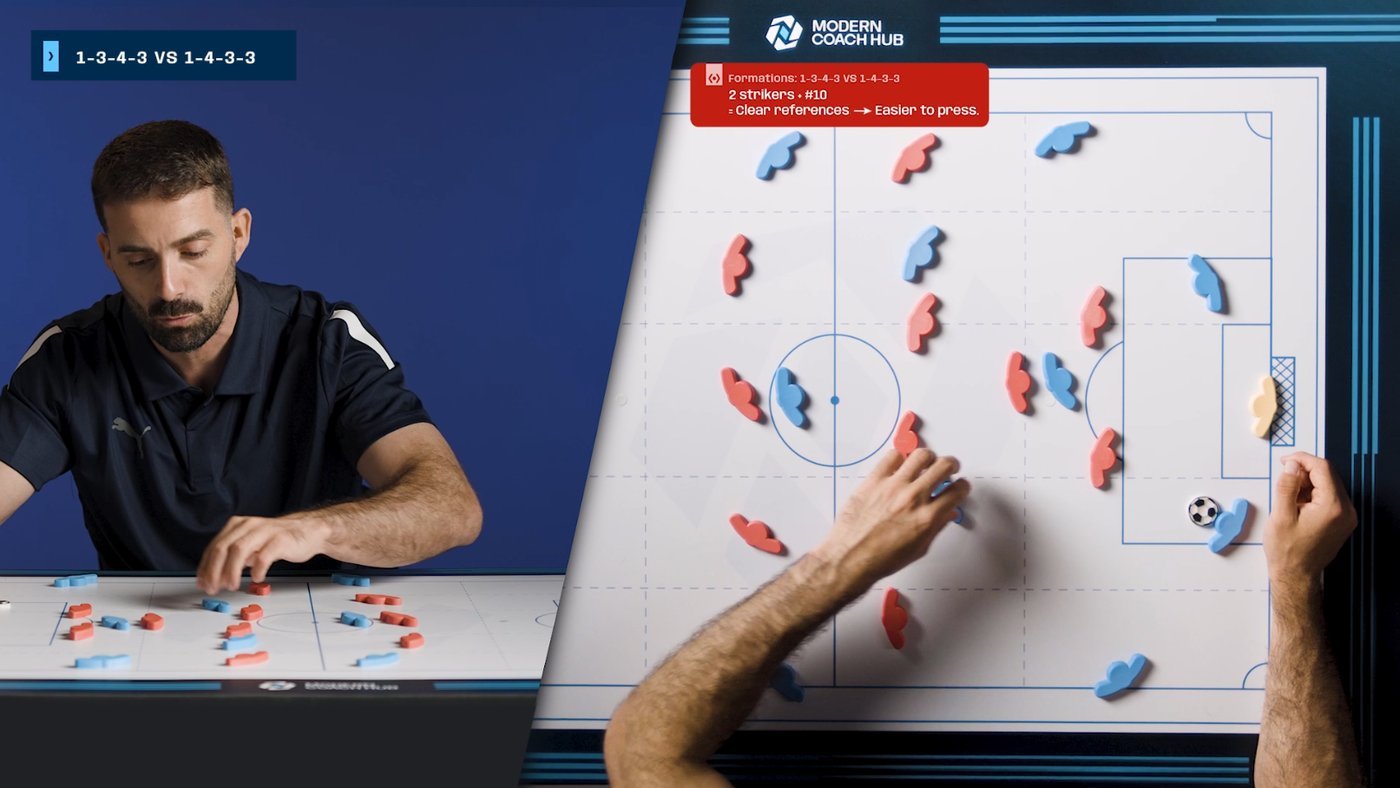
See how a matchup is read
A few minutes from inside the course. The full reading of each matchup is in its video.
Every video comes with written notes
You don't have to rewatch a video before every game. Each matchup has its own page: 3 key points, the five principles with their status in that matchup, and the Cue → If → Then decisions. This is a short extract from 1-4-3-3 vs 1-4-4-2.
Defensive · Formations · Key notes for coaches
1-4-3-3 vs 1-4-4-2
3 Key Points
| + | You choose where the ball goes. Adding the number 8 to the first line guides the opponent outside; adding the opposite winger guides him inside, onto aggressive eights. |
+ 2 more key points in the full notes
5 Collective Principles
How each one holds up in this matchup.
| 1 | Put pressure on the ball RESTORED BY THE ADJUSTMENT With one less player on the first line, everyone blocks the advance and stays compact while the striker guides the first centre-back to dribble towards one side. On the agreed trigger — the pass from one centre-back to the other — a player joins the first line: either the number 8, going straight, or the opposite winger, from outside to inside. |
| 2 | Balance and cover the pressing player HOLDS It holds as long as the jump is compensated. If the number 8 jumps, the number 6 occupies the space he left and the other eight protects space instead of acting as an eight. If the winger jumps, the eights must be ready to press aggressively inside — not behind their player, but winning the position in front of him — while one player stays behind that line for the long ball. |
+ 3 more principles in the full notes
Cue → If → Then
Six questions for the coach, each tied to the principle it protects.
| 1 | When do we leave the block? Principle 1 · Put pressure on the ball CueThe pass from one centre-back to the other
RememberEveryone blocks the advance until the agreed trigger. |
+ 5 more decisions in the full notes
Extract. The full page for this matchup has 3 key points, the 5 principles and 6 decisions, and there is one for each video.
Ten minutes before you plan the week
You know, or can guess, how Saturday's opponent builds up. Open that matchup. In about ten minutes you have:
- The principle most likely to break against them
- The adjustment and the player profiles it needs
- Two or three triggers to agree on with your players
- In most matchups, who stays ready for the counter
That's why access is by time, not forever: it's a tool for a season.
Where it fits, and where it doesn't
- You coach 11v11
- Your team has a defensive shape
- You want your players to know who presses, who covers and who stays, whatever the opponent does
- You coach 7v7 or 9v9. The principles apply, but the nine matchups are 11v11 shapes
- You're looking for a library of drills. This is about reading and adjusting
- Your players still struggle in the 1v1 and 2v2. Defensive Foundations is a better place to start
Same content, two ways in
Covers one full season. All nine matchups, the principles chapter and the written notes for every video.
Get 4-month access$97 · one paymentFall, spring and the preseason in between. Same content, three times the access.
Get full-year access$197 · one paymentOne payment. No subscription, nothing renews. Access starts the day you buy.
If you move up to Defensive Master while your access is active, what you pay today comes off the price.
Why it closes
Formations is the closing section of Defensive Master. It isn't part of the regular catalog and it has never been sold separately. I'm opening it for three days because many coaches ask about formations long before they're ready for a full Master course.
On Thursday, September 24 at 11:59 PM Pacific it closes, and it won't be offered on its own again for at least six months. After that, the only way in is Defensive Master.
Questions
What happens when my access ends?
I already own Defensive Foundations or Advanced. Do I have this?
I own Defensive Master. Should I buy this?
Do I need Foundations or Advanced first?
My team plays a 4-2-3-1 or a 3-5-2. Is it covered?
How long does it take to go through?
Bernat Mosquera

Easy coaching for complex football
I'm Bernat Mosquera, with 4+ years as a Performance Individual Analyst working with professional players in La Liga. My work across 3 continents and 5 countries taught me one thing: at every level, we have to make the game simple to teach and effective to learn.
Open until Thursday night.
Closes Thursday, September 24 at 11:59 PM Pacific.